

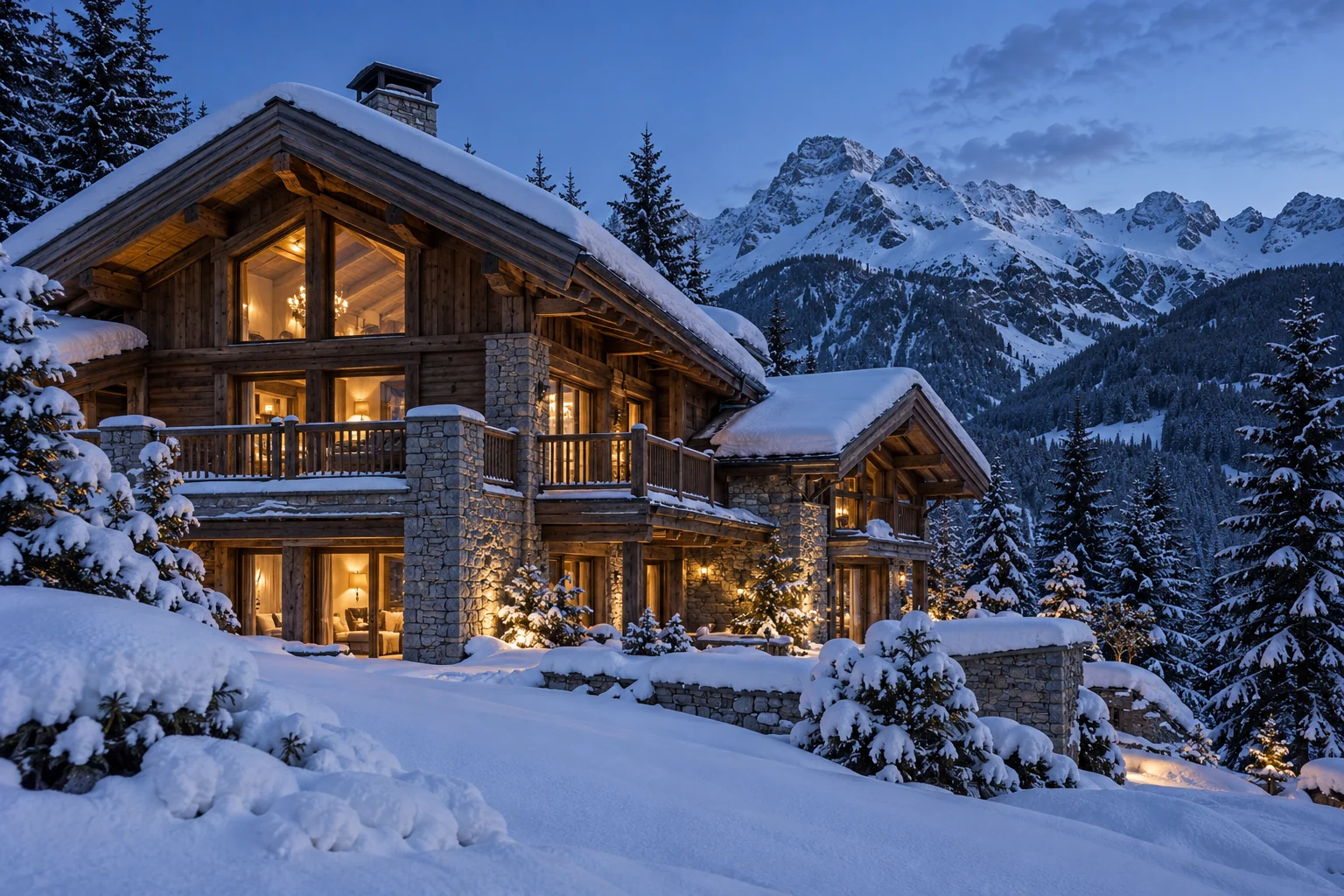
A few winter months account for most of the demand, guests all arrive on the same day and expect a chalet that is warm, cleared of snow and ready to live in: the mountains leave no margin for improvisation.
Luxury chalet management in the French Alps: a short, intense season
A high-end chalet is let first and foremost during the ski season, a brief period in which every week counts and the slightest failure is immediately paid for in negative reviews. Luxury chalet management therefore relies on meticulous preparation beforehand, flawless execution during the winter and serious maintenance for the rest of the year. Altitude, snow, cold and the distance to tradespeople complicate tasks that would be routine in a city: a heating breakdown, an access road not cleared or a spa out of order is enough to spoil a stay booked long in advance. A mountain concierge lives in the resort all year, knows its suppliers and can mobilise a team on a busy Saturday. Conciergerie.luxe introduces you, free of charge and with no commitment, to a concierge whose expertise suits your chalet; the services are carried out by that concierge, under the contract you sign directly with it.
Weekly stays: the rhythm of a chalet concierge
In ski resorts, stays are often booked by the week, frequently Saturday to Saturday, in line with school holidays and lift passes. This rhythm gives the chalet concierge a very full changeover day: guests depart and the inventory check is done in the morning, a full clean and change of linen follows, the spa and heating are checked, the welcome and groceries are prepared, then the new occupants arrive in the late afternoon, sometimes at night after a difficult journey. Several chalets are vacated on the same day, on snowy roads: team organisation, anticipation and the quality of the photo check make all the difference. The concierge must also plan for delays, late arrivals and weather surprises, with a clear procedure and someone reachable.
Heating, snow clearing, spa: the technical side of a high-end mountain concierge
A high-end mountain concierge is judged first on its technical mastery. An unoccupied chalet is kept frost-free, then preheated early enough for guests to find warm rooms and hot water available as soon as they arrive. Access must be cleared of snow, the roof monitored, and wellness equipment (spa, sauna, hammam, indoor pool) maintained and checked at every changeover. The following points deserve to be set out in black and white in the contract.
- Preheating before each arrival is scheduled, remotely or on site, and checked.
- Snow clearing of the access, terraces and parking spaces is entrusted to an identified contractor.
- The spa, sauna and hammam are regularly maintained and checked before each stay.
- The ski room, boot dryers and lockers are cleaned and checked between weeks.
- A technical on-call service can be reached throughout every stay.
Luxury chalet rental: the services guests expect
A luxury chalet rental sells as much on its services as on its space. Guests expect the ski logistics to be taken care of: rental equipment delivered and fitted at the chalet, lessons and instructors booked, lift passes handed over on arrival. A private chef, breakfast service, grocery shopping, babysitting or massages round out the offer, as do transfers from stations and airports, essential when the road is under snow. A luxury concierge in Courchevel relies on a network of regular providers to offer these services, generally invoiced to the guest. A word of caution, however: if the chalet regularly provides at least three of the following four services (breakfast, regular cleaning, household linen, guest reception), the rental becomes a para-hotel activity and is subject to VAT at 10% (art. 261 D 4° of the French General Tax Code, CGI).
Winter and summer: two seasons for luxury chalet management
Winter remains the flagship season, but summer is worth developing: hiking, lakes, golf, cycling and cool mountain air attract a family clientele that books more flexibly. A luxury concierge in Megève will thus think in terms of two seasons, each with its own minimum stays and dynamic pricing. Expectations differ: in winter, the priority is technical and logistical; in summer, it focuses more on outdoor spaces, activities and flexible dates. Finally, the shoulder seasons should not be seen as downtime: they determine the quality of both letting seasons. The table below sums up the differences that shape a concierge’s organisation and the way it presents your chalet.
| Winter | Summer |
|---|---|
| Weekly stays, often Saturday to Saturday | More flexible stays, adapted minimum lengths |
| Heating, preheating and snow clearing come first | Terraces, garden and outdoor furniture come first |
| Ski room, equipment rental, ski lessons | Hiking, lakes, cycling, golf and outdoor activities |
| Transfers in the snow from stations and airports | Easier access, guests often travel by car |
| Busy changeovers and reinforced on-call service | A steadier pace, family clientele |
Shoulder seasons
Preparing your luxury chalet for the next season
Spring and autumn, when the resort empties, are the only times when work can be done without disturbing anyone. This is the time for servicing the heating and wellness equipment, roof and joinery work, renewing the linen and carrying out a full inventory. If you use the chalet yourself for part of the year, the same team can provide second home management: regular visits, preparation before you arrive, supervision of tradespeople. These quiet periods largely determine the quality of the following season, and a serious concierge offers you a maintenance programme rather than waiting for a breakdown.
Rules in ski resorts: what chalet management requires
Mountain towns are among the most active in regulating meublés de tourisme (furnished tourist accommodation), and the rules vary from one resort to another. In Chamonix, for example, rules in force since 1 May 2025 make letting a second home subject to authorisation from the very first night, valid for three renewable years and limited to one per owner; Grand Annecy, for its part, applies quotas per town. In Les Allues (Méribel), every short-term furnished let has required a renewable three-year authorisation, without compensation, since January 2024, whereas Courchevel, Megève, Saint-Gervais and Combloux had not adopted, as at 17 October 2026, any local regime beyond the national baseline. Everywhere, the chalet must be declared and its registration number displayed on listings. The energy performance certificate weighs particularly heavily in the mountains: any new changement d’usage (change of use) application requires a DPE (energy performance certificate) rated A to E, and from 1 January 2034 furnished tourist lets that are not the host’s résidence principale (main residence) will have to be rated A to D (law of 19 November 2024, known as the loi Le Meur, Le Meur law).
Frequently asked questions about luxury chalet management in the French Alps
What commission should I expect for chalet management?
Market sources cite an average of around 20% in Chamonix and rates of 25% to 40% in winter in the mountains depending on the services included (price lists published by industry players, 2026). These are commercial orders of magnitude: compare what the commission covers and the additional fees recharged.
Must the chalet stay heated between stays?
At the very least it must be kept frost-free, then preheated early enough before each arrival. The concierge schedules these settings and checks them, remotely or on site.
How are guests welcomed in the resort?
In a high-end chalet, guests are welcomed in person rather than via a key box: a tour of the chalet, an introduction to the spa and heating, a bilingual welcome book, tips on the resort. For late arrivals, the concierge provides a suitable procedure and remains reachable.
Can a chalet be let in summer?
Yes, and it is often a season worth developing: family clientele, hiking, lakes and outdoor activities. It calls for its own pricing and minimum stays, different from winter.
Is authorisation needed to let a chalet that is a second home?
It depends on the town. Some, like Chamonix, require change of use authorisation from the first night; in every case, declaration and a registration number are mandatory.
Does Conciergerie.luxe manage my chalet directly?
No. We review your request and look for a concierge active in your resort, free of charge and with no commitment. The services are carried out by that concierge, under the contract signed directly with it.